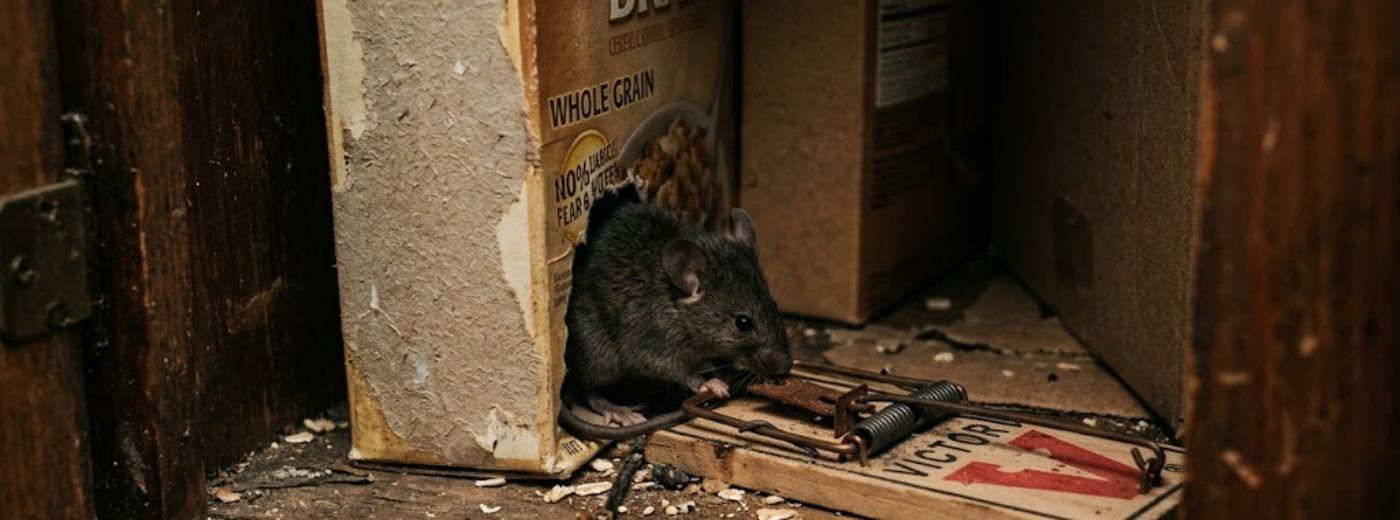
Mice control services in Macon, GA
House mouse extermination built for Macon's year-round subtropical breeding pressure. Inspection, treatment, humidity-aware exclusion sealing, and follow-up, across all of Bibb County.
House mouse extermination built for Macon's year-round subtropical breeding pressure. Inspection, treatment, humidity-aware exclusion sealing, and follow-up, across all of Bibb County.
Mice control service in Macon, GA is a year-round problem in a way it simply isn't in northern states. The house mouse (Mus musculus) breeds continuously in Macon's subtropical climate. Mild winters mean no cold-weather population reset. Macon's humidity keeps the organic material that feeds outdoor mouse populations cycling all year. A mouse problem that starts in October in Macon isn't going to solve itself by February the way it might in Ohio or Wisconsin. Without proper exclusion work, the population indoors just keeps building.
Most pest control content is written for temperate climates. The seasonal "mouse season" framing, mice move inside in fall, populations drop in spring, doesn't apply cleanly to Middle Georgia. Macon averages roughly 51 inches of rain annually and a January mean temperature well above freezing. House mice in Bibb County face no meaningful winter pressure. They breed in crawl spaces, wall voids, and attics year-round, producing litters of 5–8 pups every three weeks under the right conditions.
The humidity factor is also specific to Macon. Crawl spaces under older Bibb County homes stay warm and damp even in winter, ideal mouse nesting conditions. Dryer vent gaps, which are common in 1960s–1980s building throughout North Highlands and Avondale, provide both a warm air source and an easy entry point. The combination of no cold reset and persistent warm humid microclimates under Macon's housing stock drives a baseline mouse pressure that requires active management, not seasonal treatment.
| signs | House mouse | Norway rat | Roof rat |
|---|---|---|---|
| Droppings size | 3–6mm, tapered, rice-shaped | 12–20mm, blunt capsule | 10–14mm, pointed ends |
| Gnaw marks | Small, irregular, on soft material | Large, rough, on hard material | Medium, clean edges |
| Noise location | Wall voids, cabinets, under appliances | Crawl space, basement, heavy floor thumps | Attic, upper walls, running sounds |
| Body size if spotted | 3–4 in body + tail, small head | 10–12 in body + tail, blunt nose | 7–10 in body + tail, pointed nose, large ears |
| Entry gap tolerance | 6mm (size of a dime) | 12mm (size of a quarter) | 12mm but higher up (roofline) |
We trace mouse activity from droppings, runways, and gnaw marks to confirm species and map foraging routes. In older Macon homes this means checking inside cabinets, behind appliances, in attic corners, and along every wall penetration.
House mice enter through gaps as small as a dime. We check dryer vents, gas lines, pipe penetrations, crawl space vents, soffit-to-wall transitions, and garage thresholds, every point where something passes through an exterior surface.
Snap traps placed on confirmed runways, inside cabinets, behind appliances, along wall edges, in attic corners. We don't use glue boards (inhumane, ineffective for infestations) or interior rodenticide (creates decomposition and odor problems).
Every identified entry point sealed: copper mesh in pipe gaps, hardware cloth over vent openings, foam backer and exterior-grade sealant at wall penetrations. Return inspection at 3–4 weeks to verify activity has stopped.
Most mice treatments have one core problem. They handle the mice present without closing the entry points that allowed them in. House mice have overlapping home ranges of 30–50 feet, every house mouse in a neighborhood's wall voids is part of a shared outdoor population that will continuously probe unsealed gaps. A snap trap program without exclusion work is a recurring revenue program for the pest operator, not a solution for the homeowner.
Effective mice control in Macon requires closing the gap between where mice live outdoors (crawl spaces, landscaping, neighbor properties) and where they gain access indoors (dryer vents, pipe penetrations, crawl space vents). That gap is measured in millimeters. We seal it with materials that don't compress or deteriorate in Macon's humidity, copper mesh and hardware cloth, not steel wool or foam alone.
Standard foam sealant compresses and shrinks over time in humid conditions, leaving gaps that reopen within a season. We use foam as a backer for hardware cloth or copper mesh, not as a standalone seal, and we select exterior-grade sealants rated for Macon's humidity range. This is a detail most national operators miss because their training manuals are calibrated for drier climates. Older Macon homes face heavy weather. The exterior sees 50+ inches of rain per year and high summer humidity. Good materials hold for three years. Wrong materials are open again in six months.
Limited entry points, newer home, contained infestation. 1–3 sealing locations, snap trap program, follow-up visit.
Multiple entry points, wall void activity, crawl space access. Most single-family Macon homes fall here.
Pre-1970s building with multiple wall penetrations, crawl space, and established population across several rooms.
Full property inspection, species confirmation, entry-point map, written recommendation. No obligation.
Want a real number for your situation? Call (844) 635-0403 for a free on-site inspection. Written quote before any work begins.
House mouse contamination tends to be lighter than rat contamination but more widespread. The cleanup decisions follow the same logic: surface contact equals cleanable, urine soaking and nesting material equal replacement.
| Material or item | Salvageable? | Outcome or criteria |
|---|---|---|
| Drywall (droppings on surface only) | Yes | Enzyme treatment, repaint with sealer if odor remains |
| Drywall (urine staining or chew damage) | No | Patch and replace the affected section |
| Cabinet interiors (droppings present) | Yes | Empty fully, sanitize, replace shelf liners |
| Stored food packaging (any contact) | No | Discard, direct contamination of food contact surface |
| Pantry items in sealed glass or metal containers | Yes | Sanitize exterior, contents are safe if seal was intact |
| Stored fabric or clothing (droppings only) | Yes | Hot water wash plus enzyme sanitizer |
| Stored fabric (urine soaking or nest material) | No | Discard, urine penetrates fibers and odor persists |
| Wall cavity insulation (any contact) | No | Open the wall, remove the affected section, replace |
| Children's plush items or stored toys (any contact) | No | Discard, contamination risk too high to clean reliably |
| Stored books, paper records (light dropping contact) | Sometimes | Page-by-page wipe; replace if heavy contact or any urine |
Every materials decision goes in a written report before any removal. The decision protects both your records and any insurance documentation.
Yes. Macon's humid subtropical climate means house mice breed continuously without a true cold-weather population reset. Macon rarely gets sustained cold snaps cold enough to interrupt indoor mouse breeding. The result is that mouse pressure builds across months rather than peaking and dropping the way it does in northern states.
House mice can squeeze through any gap larger than a dime (roughly 6mm). Common Macon entry points are easy to list. Dryer vent gaps. Gas pipe penetrations. Crawl space vent screens with broken mesh. Garage door threshold gaps. Soffit-to-wall transitions on older building. Utility conduit penetrations through exterior walls.
Mice control in Macon runs $250 to $900 for standard residential work. A contained infestation in a newer home sits toward the low end. A spread infestation in an older home with multiple wall voids, a crawl space, and numerous pipe penetrations reaches the upper range. Inspections are free.
With proper exclusion work, most residential infestations clear in 2–4 weeks after treatment. Snap traps reduce the active population within the first week. Exclusion sealing prevents re-entry. A follow-up inspection at 3–4 weeks confirms activity has stopped. Homes where exclusion work is incomplete will see re-infestation from the same outdoor population.
In most cases, yes. Wall-void mice are treated by placing snap traps in the attic and crawl space where mice travel between the void and their foraging areas. Once the population is reduced, we seal the entry points that allowed access. Opening drywall is occasionally necessary for dead mouse removal or very large infestations.
We use snap traps for interior mouse work rather than rodenticide or glue boards. Snap traps are placed in low-traffic areas, inside cabinets, along wall edges, in attic corners, where pets and children don't usually go. No poison enters the home's interior.
The clearest signs: droppings (mouse droppings are 3–6mm, rice-shaped; rat droppings are 12–20mm, capsule-shaped), gnaw marks size, and noise location (mice in wall voids and cabinets; rats louder, often in attics or crawl spaces). When in doubt, call, species misidentification leads to wasted treatment.
Yes. We provide records suitable for property management records and work with property managers to coordinate unit-by-unit access. For large multi-unit buildings, we check whether a building-wide program or unit-specific treatment is more right.
Use gloves and a sealed bag, hantavirus, while rare in Middle Georgia, is a reason for caution with rodent carcasses. Ventilate before cleaning. If you're finding multiple dead mice, call us to check, it may shows a nearby rodenticide treatment and an ongoing entry-point issue.