Technician note
Bellevue's persistent issue is mice rather than rats. The subtropical climate means no seasonal die-off; the year-round outdoor population probes every gap continuously. Full exclusion plus 14 days of monitoring is what holds; one-time treatment alone returns within 6 months.
Bellevue's rodent landscape
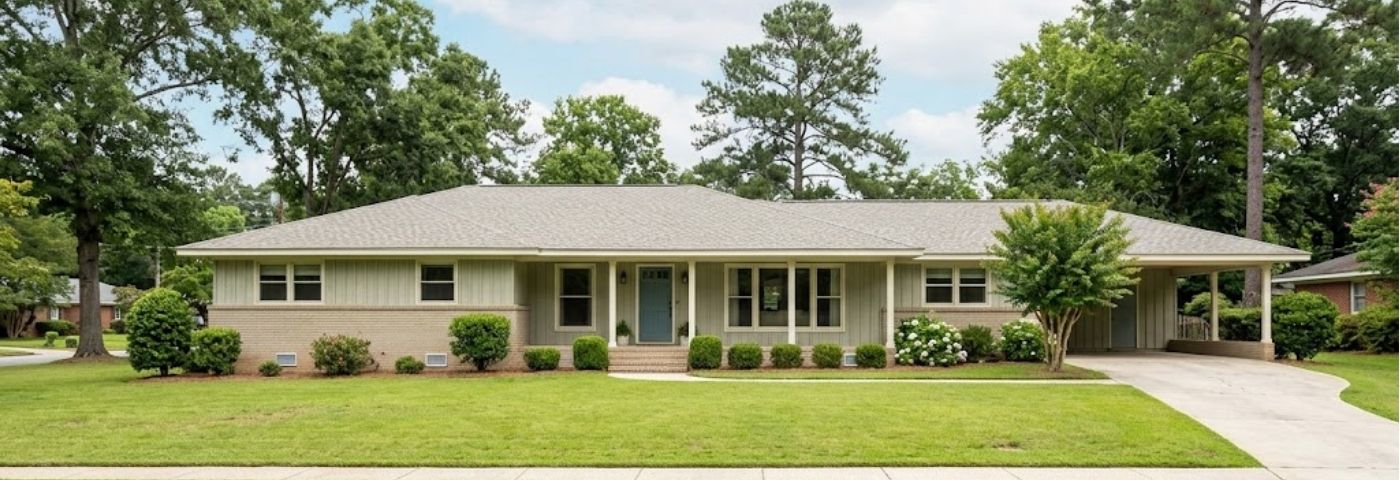
Bellevue is an established Macon residential area with housing stock spanning from older pre-war building in its core to mid-century ranch and bungalow homes in its outer sections. The rodent profile reflects this range: older Bellevue homes on blocks with established canopy share the roof rat vulnerability of Ingleside and Shirley Hills, while the mid-century ranch homes that make up much of Bellevue's housing stock have the crawl space and foundation-zone mouse and Norway rat profile common to post-war Macon neighborhoods.
House mice are the consistent thread across Bellevue's rodent calls. They're the year-round suburban baseline. They don't need a river corridor or mature canopy to sustain. Macon's warm climate keeps mice breeding all year. Bellevue's mature landscaping sustains the population. So do the ornamental beds. So does the leaf litter and mulch that builds up around mature foundation plantings. The outdoor mouse population stays at the same density year-round. Any home with gaps in the 6mm range anywhere in its building envelope, and most Bellevue homes have several, is accessible to this population continuously.
Crawl space conditions across Bellevue's housing stock
Bellevue's older crawl space homes show the same patterns as Avondale and North Highlands. That's homes built before 1970. Mudsill gaps widened over decades on high-clay soil. Foundation vent screens corroded or damaged. Pipe entry points never sealed at original work. These gaps are the reason Bellevue generates a steady volume of crawl space rodent calls, not because the neighborhood is uniquely susceptible, but because the building era and soil type produce entry points that continue to develop as the homes age. Crawl space sealing in Bellevue is a long-term investment that holds for 3–6 years with proper materials before the next round of settling opens new gaps.
Services we provide in Bellevue
Mice are the constant in Bellevue. Norway rats appear in any home with crawl space entry points; roof rats on streets with mature canopy.
— from technician inspection notes
Frequently asked questions. Bellevue rodent control
When can you reach a Bellevue address?
Same-day windows are routine for Bellevue calls. The neighborhood sits inside our priority dispatch zone. Phone (844) 635-0403.
What rodent pressure does Bellevue see?
Mice are the dominant species, year-round. Norway rats appear in any home with crawl space entry points. Roof rats show up on streets with established canopy reaching rooflines.
What does the free Bellevue inspection cover?
All five zones — roofline, attic, crawl space, foundation, interior — plus a written report with photos and a documented entry-point map.