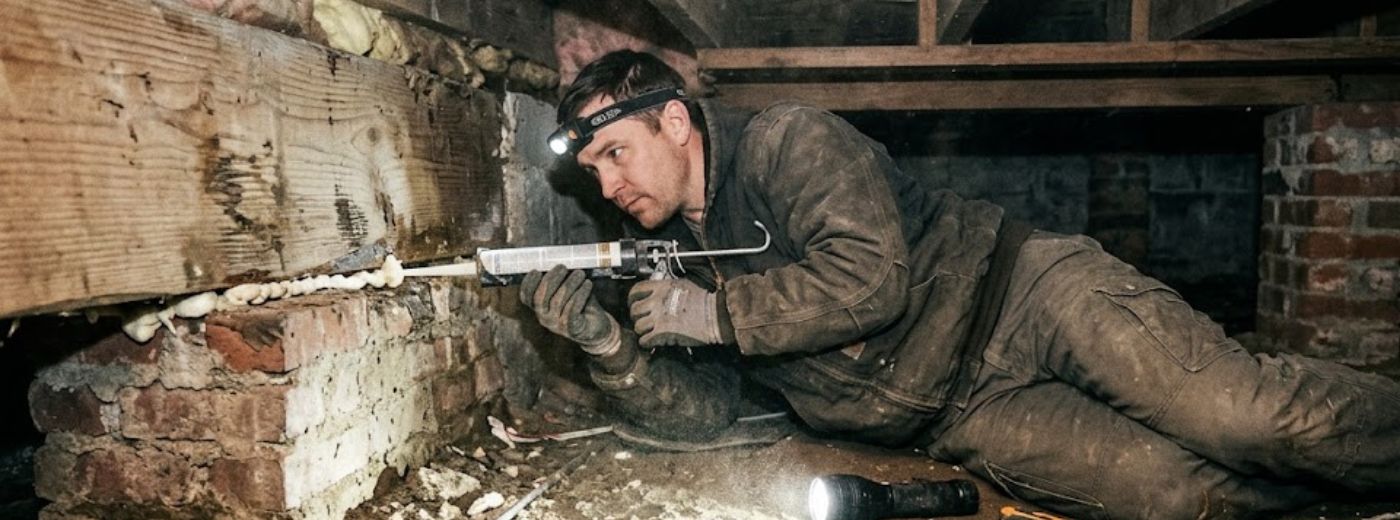
Foundation vent re-screening, mudsill gap sealing, and pipe penetration closing for the Norway rat and mouse access routes that run through Bibb County's pre-1970s crawl space housing. We enter every crawl space, exterior-only inspection misses half the gaps.
LicensedInsuredFull crawl space entry90-day warranty
Crawl space rodent sealing in Macon, GA is the highest-use exclusion action on any Bibb County home with a crawl space, because the crawl space is where Norway rats nest, where mice establish their primary access route to the interior, and where the entry points that drive whole-house infestations are concentrated. Pre-1970s Macon housing, which covers the vast majority of homes in Vineville, Ingleside, North Highlands, Avondale, Bellevue, Napier Heights, Kings Park, Lynmore Estates, and the older sections of East Macon, has unencapsulated crawl spaces with foundation vents, block gaps, and pipe penetrations that haven't been meaningfully updated since original building. Sealing these correctly, with materials that hold in Macon's high-humidity, clay-soil environment, is the work that produces durable results.
Why Macon crawl spaces need a different approach
The standard crawl space rodent sealing advice, foam the pipe gaps, replace the vent screens, is calibrated for drier climates. In Macon, foam sealant applied to a concrete foundation block face encounters two problems that don't exist in Phoenix or Denver: the high-clay soil expands and contracts with Macon's wet-dry moisture cycles, stressing the sealant bond at the concrete face, and the constant high humidity beneath unencapsulated crawl spaces accelerates foam degradation. A foam-only seal on a Macon crawl space foundation lasts 6–18 months before it pulls away from the concrete or crumbles from moisture cycling. We use mechanically fastened hardware cloth and copper mesh, with exterior-grade sealant as a secondary bond layer, because mechanical fastening holds through soil movement and humidity in ways adhesive-only products don't.
The second Macon-specific factor is soil-to-slab clearance. Many pre-1960s homes in Bibb County have crawl space clearance between 18 and 36 inches, low enough to require crawling but accessible with the right equipment. A meaningful number of Macon crawl spaces also have standing water issues seasonally, and some have soil-to-floor clearance well below 18 inches in sections. We carry the equipment to work in limited-clearance crawl spaces and check soil-moisture conditions before recommending any sealing schedule.
Crawl space entry points and seal methods
19-gauge hardware cloth
Foundation vents
Existing vent screens are inspected from inside the crawl space as well as the exterior. Corroded, bent, or absent screens are replaced with hardware cloth cut and secured to the vent frame, not aluminum window screen or flexible mesh.
Copper mesh + exterior sealant
Mudsill-to-foundation gap
The most commonly missed and most major Norway rat entry point in older Bibb County housing. The gap where the sill plate rests on the foundation block, often visible from inside the crawl space as a band of daylight around the base of the wall. Copper mesh packed into the gap and sealant-finished.
Copper mesh + sealant
Utility pipe penetrations
Water supply, gas, HVAC refrigerant, and drain lines where they pass through the crawl space foundation walls. Assessed from the interior face, exterior check alone misses penetrations on interior foundation walls.
Hardware cloth + latch hardware
Crawl space access hatches
Exterior access hatches without secure closures, or with gaps around the frame, provide direct crawl space entry. Frames re-sealed and latching hardware added where absent.
Sealant + hardware cloth
Below-grade utility entries
Utility conduit, irrigation lines, and cable entries that come up through the crawl space floor. Sealed at the floor-wall junction and at any points where the conduit enters through a foundation wall below grade.
Hardware cloth
Interior foundation wall gaps
Block gaps and mortar failures on interior foundation walls, the walls between separate sections of a divided crawl space. Often entirely missed by exterior-only inspection but provide rodent travel routes between crawl space sections.
Crawl space sealing process
1
Interior crawl space entry
We enter the crawl space on every job, exterior-only inspection misses mudsill gaps, interior pipe penetrations, and interior wall gaps visible only from inside. Inspection from inside out and outside in, every time.
2
Clearance check and soil check
We note standing water, soil moisture, and clearance before committing to a seal schedule. Some crawl spaces need drainage work before sealing is practical, we'll tell you honestly if that's the case rather than sealing over an active moisture problem.
3
Mechanically fastened sealing
Hardware cloth and copper mesh mechanically fastened, not just pressed and foam-sealed. Sealant is the secondary bond, not the primary hold. This approach survives Macon's soil movement and humidity cycles; adhesive-only doesn't.
4
Interior follow-up
Follow-up inspection includes interior crawl space re-entry to confirm sealed points from the inside, the same perspective where the entry points were found. Exterior-only follow-up misses seal failures that are only visible from inside.
Crawl space rodents in Macon? Seal at the foundation, call today.
4–6 foundation vents, limited mudsill gap issues, 1–2 pipe penetrations. Smaller crawl space with good clearance.
Standard Macon crawl space
$400 – $650
6–10 foundation vents, mudsill gap sealing, multiple pipe penetrations, access hatch reinforcement. Most Bibb County crawl space jobs.
Large or complex crawl space
$650 – $800
Large-footprint home, multiple crawl space sections, interior wall gaps, low clearance requiring extended work time, or extensive mudsill settling throughout the foundation perimeter.
Inspection
Free
Full interior and exterior crawl space inspection with written entry-point map. Soil moisture and clearance check included.
What changes the actual number:
Property size and how many zones (attic, crawl space, garage, outbuildings) need inspection
Species mix and how established the infestation is
Number of entry points needing exclusion sealing
Whether records are required for insurance, landlord, or health inspection purposes
Want a real number for your situation? Call (844) 635-0403 for a free on-site inspection. Written quote before any work begins.
Frequently asked questions, crawl space rodent sealing in Macon
Why is the crawl space the most important area to seal in Macon homes?
Macon's pre-1970s housing stock has unencapsulated crawl spaces with foundation vents, block gaps, and pipe penetrations that serve as the primary entry route for Norway rats and mice. The crawl space is warm, dark, undisturbed, and connects directly to the home interior through pipe chases. It's the single highest-use exclusion action on any Macon home with a crawl space.
What does crawl space rodent sealing involve?
Foundation vent re-screening with hardware cloth, mudsill-to-block gap sealing with copper mesh and sealant, utility pipe penetrations closed on the interior face, crawl space access hatch reinforcement, and below-grade utility entry sealing. We enter the crawl space on every job.
What animals does crawl space sealing keep out?
Norway rats and house mice are the primary targets. Roof rats almost never use crawl space entry, they access homes at roofline level. Crawl space sealing is calibrated for Norway rat (12mm) and mouse (6mm) gap thresholds.
How much does crawl space rodent sealing cost in Macon?
$250 to $800 depending on foundation vent count, mudsill gap extent, and pipe penetrations. A smaller home with limited gaps sits at the low end. A larger pre-1960s home with extensive mudsill settling and multiple sections reaches the upper end. Inspections are free.
Do you actually enter the crawl space?
Yes, always. Exterior-only inspection misses mudsill gaps, interior pipe penetrations, and interior wall gaps. We enter on every crawl space rodent sealing job.
How does Macon's clay soil and humidity affect sealing?
Clay soil expands and contracts with moisture cycles, stressing adhesive-only sealant bonds on concrete. Constant high humidity accelerates foam degradation. We use mechanically fastened hardware cloth and copper mesh, mechanical fastening holds through Macon's soil movement and humidity cycles where adhesive-only doesn't.
Should I encapsulate my crawl space before or after rodent sealing?
After rodent sealing. Encapsulation doesn't seal rodent entry points and can make infestation harder to detect by covering evidence. Seal rodents out first, then encapsulate if you're adding a vapor barrier program.
My crawl space has active Norway rat activity, do you seal during treatment?
No. We don't seal the perimeter until trap activity has dropped to near-zero. Sealing foundation vents while rats are actively nesting in the crawl space traps them inside, creating a decomposition and odor problem. Trap program first, clearance confirmed, then sealing.