Canopy-access attic programs for Macon's historic neighborhoods. Vineville, Ingleside, Shirley Hills, where the pecan and live-oak canopy meets early-1900s soffit returns. Species-specific removal, roofline exclusion, canopy check.
Roof rat removal in Macon, GA is a specialized service that most general pest operators get wrong, because they treat roof rats like Norway rats and miss the half the job that actually matters. The roof rat (Rattus rattus) is an arboreal climber that lives in the upper canopy, travels the roofline, and nests in attics. In Macon it's concentrated in the neighborhoods with the oldest trees: Vineville, Ingleside, Shirley Hills, Avondale, and the older sections of Bloomfield. Treating a roof rat infestation without addressing canopy access and roofline exclusion is a 90-day fix at best. This page covers what a complete roof rat program in Macon actually involves.
Roof rats followed the same migration path as the Old World ship trade that brought them to North America, they're most common in port cities and subtropical coastal regions. Macon is neither a port nor coastal, but its subtropical climate and the mature tree canopy planted by early-20th-century residents created ideal roof rat habitat that persists today. The pecan, live-oak, magnolia, and crepe myrtle corridors throughout Macon's historic districts form a continuous aerial network connecting block to block. A roof rat doesn't need to walk along the ground to travel from the Ocmulgee to Vineville, it can run the canopy the entire way.
The housing stock in those neighborhoods compounds the problem. Early-1900s building used wood-shingle vents at the ridge, open soffit returns at the eave, and gable vents with wooden louvers, all of which deteriorate over a century and leave gaps large enough for a roof rat (which can fit through a gap the size of a half-dollar). A house built in 1915 in Vineville and kept up but never properly sealed may have accumulated 8–12 distinct rat entry points at the roofline alone. National pest operators calibrate their inspection checklists for modern building. We calibrate ours for Macon's actual housing stock.
Wood-shingle or early plastic ridge vents on pre-1970s homes deteriorate and warp, leaving gaps at every joint. The ridge is the warmest part of the attic, first choice for nesting.
Open soffit-to-rafter gaps at the eave, especially on homes with exposed rafter tails. Screen mesh deteriorates over decades; aluminum screen on a 1925 house is usually long gone.
Wooden louver gable vents with missing or corroded screens. Both east and west gables need to be checked, roof rats will probe every opening on the roofline.
The flashing-to-wall transition on dormers is a common failure point on older Macon homes. Gaps of half an inch at a dormer corner are enough.
Any branch within 3–4 feet of the roofline is a potential launch point. Roof rats can clear a 4-foot horizontal gap from a branch. Canopy above the roofline is worse.
Conduit entries through the upper fascia or roofline. HVAC line-set penetrations, cable runs, and antenna mounts, all create roofline gaps in older building.
Where downspouts meet the fascia, small voids can form and allow access behind the fascia board into the soffit cavity.
Chimney surround flashing gaps on older brick chimneys, especially where the chimney meets the roof deck, are a reliable roof rat entry on pre-1950s Macon homes.
| Characteristic | Roof rat | Norway rat |
|---|---|---|
| Climbing ability | Excellent, travels canopy and exterior walls easily | Poor, ground-oriented, rarely climbs above foundation level |
| Nest preference | Attic insulation, upper wall cavities, tree cavities | Burrows, crawl spaces, basements |
| Entry level | Roofline, soffit, ridge, gable, dormer | Foundation, floor grade and below |
| Primary Macon habitat | Canopy neighborhoods (Vineville, Ingleside, Shirley Hills) | Ocmulgee corridor, downtown alleys, East Macon |
| Dropping shape | 10–14mm, pointed at both ends | 12–20mm, blunt capsule |
| Noise pattern | Light rapid scurrying across attic deck, upper walls | Heavy thumping in crawl space or lower walls |
| Treatment priority | Roofline exclusion + canopy trimming | Foundation exclusion + crawl space sealing |
We inspect from ground level, eave level, and inside the attic, all three perspectives are necessary to find every gap. Ground inspection misses soffit damage. Attic-only inspection misses exterior entry angles. All three, every time.
We identify every branch within 4 feet of the roofline and mark canopy trimming recommendations on the inspection report. If canopy access isn't addressed, exclusion alone won't hold.
Snap traps placed on confirmed attic runways, along joists, in corners, near the nesting site if locatable. Trapping runs before exclusion sealing to avoid sealing active rats inside.
All mapped entry points sealed: ridge vents re-screened or replaced, soffit returns capped with hardware cloth, gable vents re-screened, dormer flashing sealed, utility penetrations closed. 90-day warranty on sealed points.
Many of our roof rat calls come from Vineville and Ingleside homeowners who are managing historic properties, are members of neighborhood preservation associations, or are simply committed to keeping the original character of early-1900s building. Rodent exclusion doesn't have to be visually disruptive. Our approach on heritage homes uses materials that match original surface finishes where possible, hardware cloth in stead of foam, and we avoid altering historic architectural details when functional alternatives exist. We've done enough pre-1930s Macon bungalow work that "heritage-compatible" isn't a marketing phrase for us, it's just how the work gets done in these neighborhoods.
Recently discovered colony, limited canopy access, 2–4 roofline entry points. Newer home with fewer structural vulnerabilities.
Established colony, full attic treatment, 4–8 roofline entry points sealed. Most Bibb County roof rat jobs fall here.
Pre-1950s building with extensive roofline gaps, canopy on multiple sides, established colony. Vineville and Ingleside bungalows often land here.
Full roofline and attic inspection with entry-point map and canopy trimming recommendations. No obligation to proceed.
Want a real number for your situation? Call (844) 635-0403 for a free on-site inspection. Written quote before any work begins.
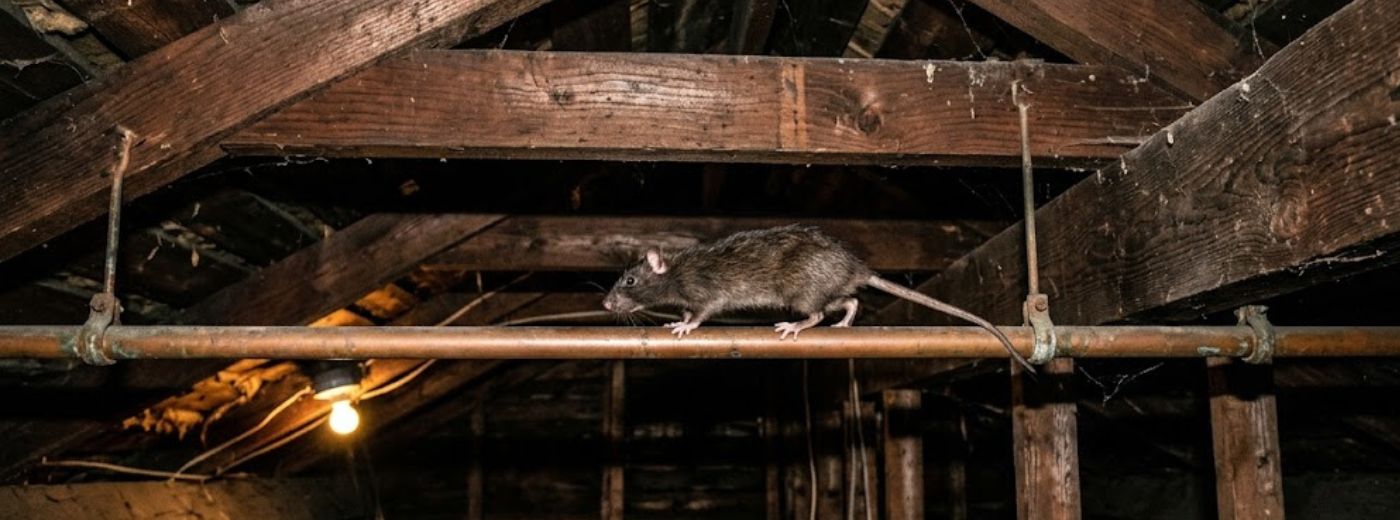
A roof rat (Rattus rattus) is a slender, agile species distinct from the heavier Norway rat. Roof rats are excellent climbers, they travel tree canopy, fences, power lines, and exterior walls to reach rooflines. In Macon they're the primary attic species in neighborhoods with mature pecan or live-oak canopy.
The most common route in Macon is a pecan or live-oak branch within 3–4 feet of the roofline. Once at the roof, they enter through wood-shingle ridge vents, damaged soffit screens, open gable vents, dormer flashing gaps, utility conduit entries, and HVAC penetrations. Pre-1960s Macon building has almost all of these vulnerabilities by default.
Roof rat signs: rapid light scurrying sounds along upper walls and attic deck at night; droppings 10–14mm with pointed ends in attic corners; grease marks along attic joists; nests in upper insulation. Norway rats in crawl spaces sound heavier, slower, and lower.
Roof rat removal runs $450 to $1,800 depending on colony size, infestation duration, and roofline exclusion extent. A recently discovered small colony on a newer home sits at the low end. A long-established colony in a 1920s Vineville bungalow with multiple soffit gaps and canopy on three sides reaches the upper end. Inspections are free.
In most cases, yes. Sealing attic entry points without removing canopy access creates a temporary fix, roof rats will find new gaps if they can still reach the roofline. We identify which branches need trimming and can coordinate with a local arborist.
Yes. Roof rats gnaw on electrical wiring insulation for nesting material. An established colony over 12–18 months can compromise enough wiring to create a fire risk. If you find gnaw marks on attic wiring, treat the infestation as urgent and have an electrician inspect after it's cleared.
Vineville, Ingleside, and Shirley Hills generate the highest volume of roof rat calls, all three have early-1900s housing stock under mature pecan and live-oak canopy. Bloomfield and Lake Wildwood see regular pressure. The pattern follows the canopy.
With snap traps on attic runways and simultaneous roofline exclusion, most infestations clear in 3–5 weeks. A follow-up inspection at 3–4 weeks confirms activity has stopped. Long-established large colonies may take longer.
If roofline exclusion is complete and canopy access is trimmed, re-infestation is unlikely. If canopy is left intact and overhangs the roofline, roof rats from the neighborhood population will probe sealed entry points and find or create new gaps over time.