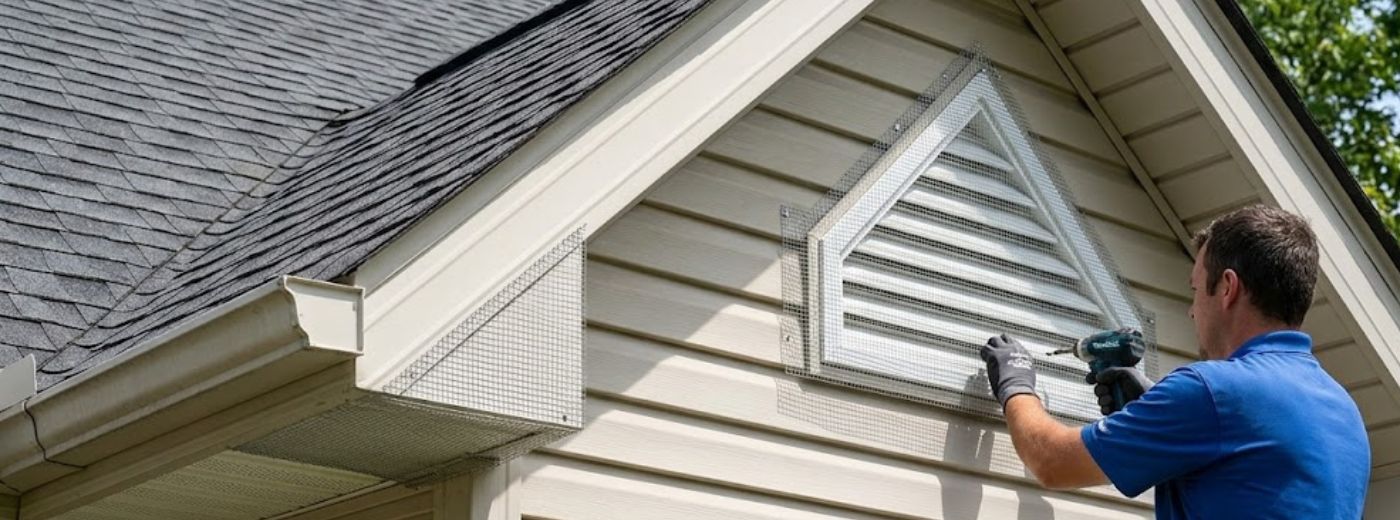
Ridge vent, soffit, gable, and dormer sealing for the roof rat attic infestations that define Vineville, Ingleside, and Shirley Hills. Three-perspective roofline inspection, ground, eave, and inside the attic, before a single gap gets sealed.
Attic rodent proofing in Macon, GA is roofline-specific exclusion work. It targets roof rat attic infestations. Those are the main rodent problem in the city's mature-canopy neighborhoods. It's the follow-up to roof rat removal. Once trapping has cleared the active population, proofing closes every roofline entry point. That way the outdoor colony can't re-establish in the same attic space. This service covers the upper building envelope only: ridge vents, soffit returns, gable vents, dormer flashing, roofline utility penetrations, and canopy trimming coordination. If foundation-level or wall-level gaps are also present (Norway rat or mouse access), those are addressed separately under the full exclusion program.
Why Macon's rooflines are uniquely vulnerable
Most attic rodent proofing guides are written for newer building. 2010 builds. Prefab ridge caps. Vinyl soffit panels. Aluminum gable vents with intact screens. That kind of building is mostly self-proofed from new. Weak spots only develop slowly. Macon's historic neighborhood housing is the opposite. A 1918 bungalow in Vineville has a wooden ridge vent assembled on-site from individual boards, soffit returns open to the rafter bay behind a decorative fascia board, wooden louver gable vents that were last screened in the 1970s, and canopy that has grown continuously for a century. The gap inventory on that home is 6–15 distinct roofline entry points, most of them invisible unless you look from inside the attic, at eave level, and from the ground simultaneously.
We inspect from all three perspectives on every attic proofing job, because that's the only way to find the gaps that don't show from any single vantage point. Ground inspection catches canopy proximity and obvious fascia gaps. Eave-level inspection catches soffit return voids. Interior attic inspection catches where daylight enters through ridge and gable voids and where the roof deck meets the wall framing at the eave, a consistent gap on homes with open rafter tails. Missing any of these perspectives means missing entry points that the outdoor roof rat population will find and use.
Roofline entry points and how we seal them
Hardware cloth re-screen
Ridge vents
Pre-1970s Macon homes have wood-shingle ridge vents assembled from individual boards with gaps between them, not modern prefab ridge caps. We inspect from inside the attic to find every daylight gap at the ridge and seal with hardware cloth stapled and sealant-set to the interior face.
Hardware cloth cap
Soffit returns
The open gap between the top of the fascia board and the first rafter, exposed on homes with open rafter tails and decorative fascia. Capped with hardware cloth cut and fitted to the soffit-to-rafter gap, stapled at 4-inch intervals, and sealant-finished.
Hardware cloth re-screen or full replacement
Gable vents, both faces
East and west gable vents both need inspection, roof rats probe all exposed faces. Wooden louver vents with deteriorated or absent screens are re-screened or replaced with rodent-resistant equivalents. Both gable vents addressed in every engagement.
Exterior-grade sealant + flashing
Dormer flashing
The flashing-to-wall gap at dormer returns, common failure point on homes where original lead or step flashing has pulled away from the wall. Sealed with exterior-grade polyurethane sealant and flashing backer where the gap requires structural backing.
Copper mesh + sealant
HVAC and utility at roofline
Condenser line-set entries, electrical mast penetrations, and cable/antenna mounts at the fascia or roofline. Copper mesh backer and exterior sealant around each penetration.
Sealant at fascia junction
Downspout termination
Where downspouts meet the fascia, small voids form between the strap mount and the fascia board edge. Sealed with exterior sealant. Minor detail but consistently probed by roof rats navigating the roofline perimeter.
Attic proofing process
1
Three-perspective inspection
Ground-level, eave-level, and interior attic inspection, all three before any gap is sealed. Every entry point recorded by location, size, and seal material. Canopy access branches identified.
2
Clearance confirmation
We verify roof rat activity has stopped before sealing, snap trap hits at zero, no fresh droppings in attic corners. Active infestation means more trapping time before proofing begins.
3
Material-matched sealing
Hardware cloth for vent re-screening, exterior sealant for flashing gaps, copper mesh for utility penetrations, sheet metal flashing for structural roofline transitions. Canopy trimming coordinates separately.
4
Follow-up inspection
Roofline walk 2–4 weeks post-sealing. Sealed points checked from all three perspectives. Re-sealing included within the 90-day warranty if any sealed point reopens.
Scratching in your Macon attic? Seal it before next season's colony moves in.
3–5 roofline entry points. Newer building with prefab ridge and intact vinyl soffit, only gable vents and utility penetrations usually need work.
Standard historic district
$550 – $750
5–9 roofline entry points across ridge, soffit, gable, and dormer. Most Vineville, Ingleside, and Shirley Hills jobs fall here.
Complex older home
$750 – $950
Pre-1920 building with open soffit returns, deteriorated ridge vent, gable vents on multiple faces, dormers, and canopy on 3+ sides of the roofline.
Inspection
Free
Three-perspective roofline inspection with written entry-point map and canopy trimming recommendations. No obligation to proceed.
What changes the actual number:
Property size and how many zones (attic, crawl space, garage, outbuildings) need inspection
Species mix and how established the infestation is
Number of entry points needing exclusion sealing
Whether records are required for insurance, landlord, or health inspection purposes
Want a real number for your situation? Call (844) 635-0403 for a free on-site inspection. Written quote before any work begins.
Frequently asked questions, attic rodent proofing in Macon
What does attic rodent proofing involve in Macon?
Attic proofing covers the full roofline envelope: ridge vent re-screening or replacement, soffit return capping, gable vent re-screening on both faces, dormer flashing sealing, HVAC and utility penetration closing, and downspout termination gap sealing. On older Macon homes, usually 6–12 entry points across these zones.
Why do so many Macon attics have roof rat problems?
Mature pecan and live-oak canopy throughout historic neighborhoods gives roof rats an aerial highway to rooflines. Pre-1960s building uses wood-shingle ridge vents, open soffit returns, and wooden louver gable vents that deteriorate over a century, a gap inventory that doesn't exist at this scale in most other Georgia cities.
How much does attic rodent proofing cost in Macon?
$350 to $950 for most residential properties. A newer home with 3–5 roofline points sits at the low end. A pre-1950s bungalow with multiple deteriorated soffit returns, unscreened ridge, gable vents, and canopy on multiple sides reaches the upper end. Inspections are free.
Does attic proofing include cleanup after a roof rat infestation?
Attic proofing and attic cleanup are separate services. Proofing seals entry points. Cleanup, droppings removal, contaminated insulation removal, sanitization, is a separate engagement handled under our attic cleanup and sanitization service.
Can roof rats re-enter through a proofed attic?
Not through properly sealed points, hardware cloth and sheet metal hold against roof rat gnawing. Re-entry risk comes from new gaps: canopy growth re-establishing access, storm damage, or structural settling. The 90-day warranty covers sealed points. Annual inspection catches new gaps.
Do I need to trim my trees as part of attic proofing?
Almost always yes for homes with overhanging canopy. Sealing the roofline without trimming branches within 3–4 feet means roof rats can still reach the roof, probe new seals, and find or create new gaps within a season. We identify which branches need trimming in the inspection report.
What's the difference between attic proofing and general rodent exclusion?
Attic proofing is roofline-specific, ridge, soffit, gable, dormer. General exclusion covers all three zones: roofline, wall, and foundation. On homes with only roof rat activity, attic proofing may be the right scope. On most older Macon homes, full exclusion covers all zones because multiple species often share the same property.
Should I get attic proofing done before or after removing the roof rats?
Always after removal is confirmed. Sealing before or during an active infestation traps rats inside the attic, they die in place over 1–3 weeks, creating a major odor problem. Sequence: attic trapping first, confirmed clearance, then proofing.