Rodent control in Vineville, Macon GA
Roof rat attic programs for Macon's most canopy-heavy historic neighborhood, and heritage-compatible exclusion for the early-1900s Craftsman bungalows and colonials that define Vineville.
Roof rat attic programs for Macon's most canopy-heavy historic neighborhood, and heritage-compatible exclusion for the early-1900s Craftsman bungalows and colonials that define Vineville.
Vineville's mature pecan canopy gives roof rats direct access to rooflines that ground-level baiting can't address. The inspection has to start at the roof, not the foundation. If we're not asking about your soffit returns and ridge venting, we're missing the actual entry point.
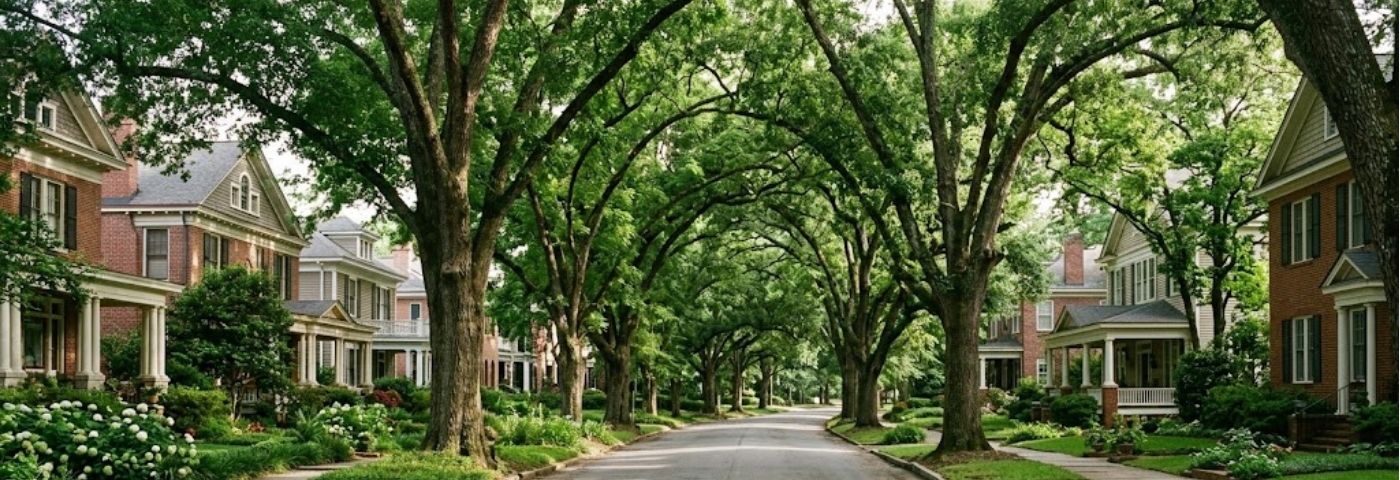
Vineville is Macon's highest-volume roof rat call neighborhood. It's not close. The cause is unique in Bibb County. The oldest, tallest, densest private tree canopy in the city. Mature pecan, live oak, and hackberry. Grown for a century straight. All layered over the oldest residential housing in Macon. The canopy gives roof rats an aerial highway to every roofline. The housing provides exactly what roof rats need once they arrive: wood-shingle ridge vents, open soffit returns under exposed rafter tails, and wooden louver gable vents that have been weathering for over a hundred years. A 1915 Vineville bungalow with an unmanaged canopy overhead and an un-proofed roofline is the ideal roof rat habitat.
Vineville is also our home address. We operate from 3180 Vineville Ave. We've inspected more Vineville attics than any other neighborhood in Bibb County. The building patterns are consistent. Pre-1940 homes use balloon framing. So traps need to go in three places at once. The attic level. The wall-floor junction. The crawl space. Heritage-friendly exclusion uses copper mesh and stainless hardware. Not expanding foam. Not on old-growth heart pine. These aren't adjustments we make reluctantly, they're the standard approach for this housing stock.
Sealing a Vineville roofline without trimming the branches that reach within 3–4 feet of the roofline is a temporary fix. The branch gives roof rats continuous access to the roofline perimeter, where they probe new seals and find or create gaps within one season. We identify canopy trimming recommendations as part of every Vineville roofline inspection, which branches, to what clearance, and coordinate with arborists when needed. Tree work isn't our trade, but identifying what's needed is part of the inspection.
Vineville roof rat activity follows a predictable seasonal pattern. Fall cold snaps (October–November) trigger the year's largest surge as roof rats settle deeper into warmed attic spaces. February and March bring the second-highest call volume as the Cherry Blossom Festival approaches and short-term rental hosts discover activity in properties that have been quietly infested all winter. The preventive window that Vineville homeowners consistently underuse is August–September, the last warm month before the fall surge, and the optimal time to seal before activity peaks.
Same day for most addresses. We routinely cover Vineville and the adjacent historic blocks on short notice because we're based on Vineville Avenue ourselves — closest of any operator in the city. Call (844) 635-0403 and dispatch will confirm a window.
Roof rats, by a wide margin. The pre-1940 housing stock and the century-old pecan canopy together create the most accessible roof rat environment in Bibb County. Mice are constant in the older crawl spaces. Norway rats appear only occasionally, mostly on blocks near drainage.
Yes, no charge. The visit covers the roofline, attic, crawl space, foundation perimeter, and interior — five zones, written report at the end. The report is yours whether you book treatment or not.