Ocmulgee corridor burrow programs, crawl space treatment, and foundation exclusion for Bibb County's ground-level rat species. East Macon, Fort Hill, Downtown, and every other neighborhood where Norway rats press upland from the river.
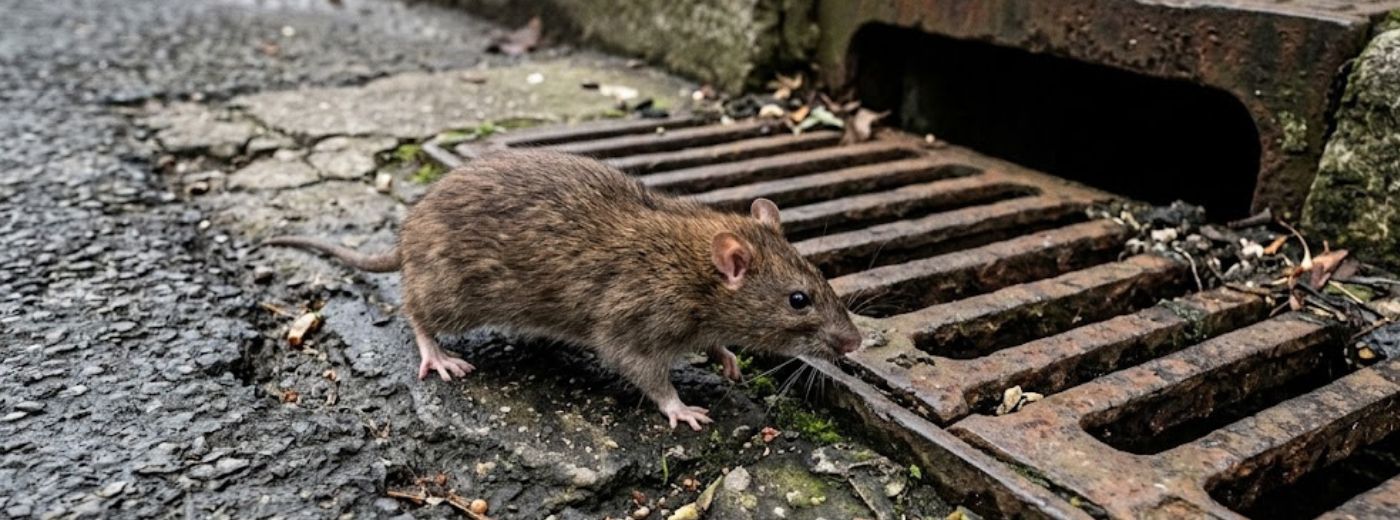
Norway rat control in Macon, GA is fundamentally different from roof rat control, and treating the wrong species means treating the wrong part of the building. Norway rats (Rattus norvegicus) are ground-level animals. They burrow, they travel at grade, and they enter homes through foundation-level gaps, crawl space vents, utility penetrations below the floor line, garage thresholds, and mudsill gaps. In Macon, Norway rat pressure is highest near the Ocmulgee River corridor in East Macon and Fort Hill, in the commercial alleys between downtown and the river, and in older residential neighborhoods with unencapsulated crawl spaces and aging foundation vents throughout the city.
The Ocmulgee River and Norway rat pressure in Macon
The Ocmulgee River runs roughly north-south through Macon, with its major urban stretch passing through East Macon and the southern edge of downtown. Norway rat colonies have colonized the riverbanks, mostly the earthen levee faces, the high-water debris accumulations, and the vegetated margins, and those colonies are self-sustaining year-round. They don't need to enter homes to survive. The residential problem happens in two scenarios: displacement from flooding, and opportunistic expansion into adjacent properties.
When the Ocmulgee rises, a regular occurrence with Middle Georgia's weather patterns, it saturates Norway rat burrows. Displaced rats move upland, probe foundation vents, and can establish in crawl spaces within 24–48 hours if entry points are available. We track Ocmulgee water levels because the flood-displacement pattern is that predictable: calls start 48–72 hours after a major rain event from East Macon, Fort Hill, and the blocks between the river and downtown. Homes in those areas that have unsealed foundation vents or broken crawl space screens will see Norway rat activity after every major rain. The solution is exclusion between flood events, not treatment after them.
Norway rat vs. roof rat, the ground-level distinction
Factor
Norway rat
Roof rat
Body size
10–12 in body + tail, 7–18 oz
7–10 in body + tail, 4–9 oz
Build
Heavy, blunt nose, small ears, thick tail
Slender, pointed nose, large ears, long tail
Climbing
Poor, ground-oriented
Excellent, arboreal species
Nest location
Underground burrows, crawl spaces, basements
Attic insulation, upper wall cavities
Entry level in home
At grade and below (foundation, floor)
Roofline (soffit, ridge, gable, dormer)
Dropping shape
12–20mm, blunt capsule, rounded ends
10–14mm, pointed at both ends
Sound
Heavy thumping in crawl space, lower walls
Light rapid scurrying in attic, upper walls
Macon pressure zones
East Macon, Fort Hill, Downtown, Ocmulgee margin
Vineville, Ingleside, Shirley Hills, Bloomfield
DIY vs. pro Norway rat control in Macon
Norway rats are large, strong, and trap-neophobic, meaning established populations learn to avoid new objects in their environment. DIY control works in limited situations and fails in others. Here's an honest breakdown.
Situation
DIY viable?
Why / why not
Single rat in garage or shed
Yes
Snap trap (Victor or T-Rex) with peanut butter bait placed along the wall, not in the open floor. Works if it's one or two animals.
Crawl space infestation
Rarely
Crawl space entry-point location and sealing requires knowing what to look for and what materials hold in Macon's humidity. Hardware store foam fails in months.
Multiple entry points
No
Missing even one entry point means re-infestation. Full perimeter inspection is necessary to find all gaps reliably.
Ocmulgee-adjacent properties
No
The outdoor source colony is too large for DIY trapping to keep pace with. Exclusion is the only durable solution.
Burrows in yard
Limited
Snap traps at burrow entrances can reduce yard population. Won't help if the foundation isn't simultaneously sealed.
Commercial or multi-unit
No
records requirements, scale, and the complexity of shared walls make DIY impractical for commercial Norway rat work.
Our Norway rat control process
1
Crawl space and foundation inspection
We enter the crawl space and inspect every foundation vent, mudsill gap, pipe penetration, and block void. Ground-level perimeter walk for burrow signs, entry grease marks, and disturbed soil. This takes time on older Macon homes, we don't rush it.
2
Identify and confirm species
Dropping size and shape, runway location (floor level vs. upper walls), and entry point height confirm Norway vs. roof rat. Mixed infestations do occur in Macon, both species in the same property, and need both treatment plans.
3
Ground-level snap trap program
Traps placed along confirmed runways at floor level, against walls, in crawl space corners, at foundation vent interiors. Bait with peanut butter or nesting material. Return visits to collect and reset. No interior rodenticide.
4
Foundation exclusion
Every identified entry point sealed: foundation vents re-screened with 19-gauge hardware cloth, mudsill gaps filled with copper mesh and exterior-grade sealant, utility penetrations closed. Humidity-tested materials only, no foam-only seals.
Norway rat in your crawl space? Call before the next rain.
Frequently asked questions. Norway rat control in Macon
What is a Norway rat and how do I know if I have one?
Norway rats are 10–12 inches body plus tail, heavyset, blunt-nosed, brownish-gray. They're ground-oriented burrowers. Field signs: large blunt droppings 12–20mm at floor level, heavy thumping in the crawl space at night, burrow holes near the foundation, grease marks along base-level wall-floor junctions.
Why does East Macon get so many Norway rats?
The Ocmulgee River supports lasting large Norway rat burrow colonies in the banks. Those colonies displace upland into homes during heavy rain when burrows are saturated. East Macon, Fort Hill, and downtown commercial blocks are all within the displacement radius.
Do Norway rats ever get into attics?
Almost never. If the activity is in the attic, it's almost certainly roof rats. Norway rats are poor climbers, they don't travel tree canopy and don't enter through roofline gaps. Norway rats in Macon homes are in crawl spaces, lower walls, basements, and ground-floor areas.
How do Norway rats get into Macon homes?
At or below grade: foundation vent screens with missing or damaged mesh, utility pipe gaps below the floor line, garage door threshold gaps wider than a half-inch, crawl space access hatches without secure closures, and mudsill-to-foundation gaps from decades of settling.
How much does Norway rat control cost in Macon?
Norway rat control runs $350 to $1,400. A single entry point with a contained infestation sits at the low end. A multi-entry program on an older home with an unencapsulated crawl space and river adjacency reaches the upper end. Inspections are free.
Can I get rid of Norway rats without calling a pro?
For a single rat in a garage, DIY snap traps can work. For an established infestation with crawl space activity, pro treatment is more effective, correct trap placement takes experience, and exclusion sealing requires materials that hold in Macon's humidity, which hardware store foam alone doesn't provide.
Are Norway rats dangerous to my home's structure?
Yes, they gnaw on structural members, insulation, and wiring in crawl spaces. Gnawed wiring is a fire and electrocution risk. Burrows near foundations can also undermine soil compaction adjacent to footings on older properties.
How long does Norway rat treatment take to work?
With correct snap trap placement and entry points sealed, Norway rat activity in a home usually drops a lot within 7–10 days. Full clearance is usually confirmed at the 3–4 week follow-up. River-adjacent homes may need follow-up perimeter monitoring because the outdoor source colony persists.
What areas of Macon have the most Norway rat calls?
East Macon and Fort Hill (Ocmulgee corridor), Downtown (Cherry Street restaurant corridor), North Highlands, Napier Heights, and Lynmore Estates (older crawl space housing). The downtown commercial Norway rat population also pressures Unionville and Avondale adjacencies.