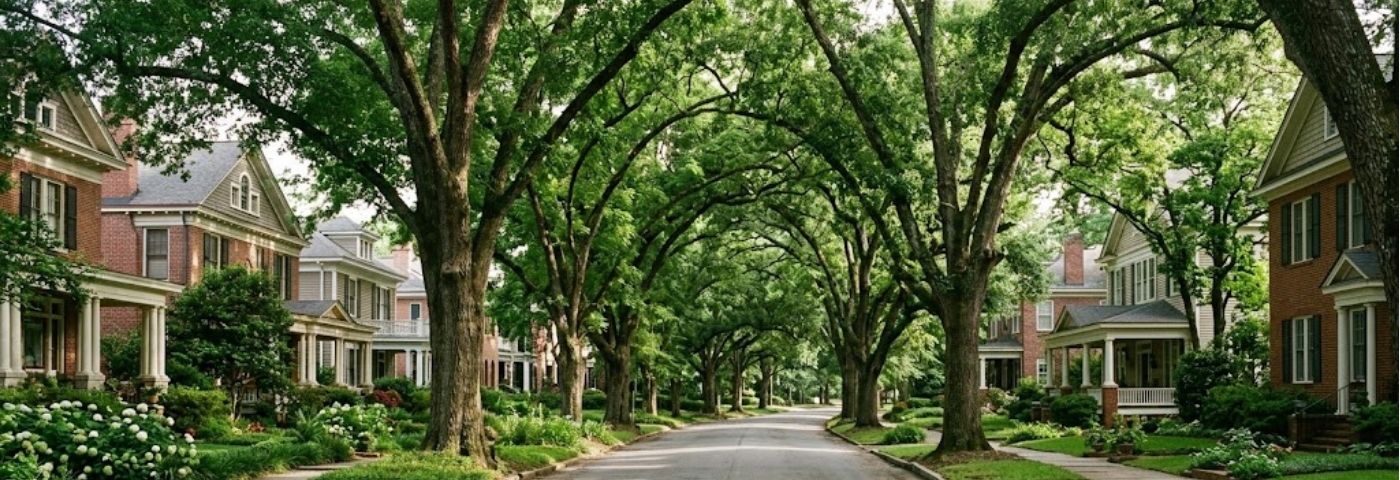
Rodent control in Shirley Hills, Macon GA
Roof rat attic programs and exclusion for Shirley Hills' post-war colonial and ranch homes, where a mature canopy overhead and 1940s–1960s building produce consistent year-round roof rat pressure.
Roof rat attic programs and exclusion for Shirley Hills' post-war colonial and ranch homes, where a mature canopy overhead and 1940s–1960s building produce consistent year-round roof rat pressure.
Shirley Hills mixes building eras block by block. We don't apply a Vineville-style approach to a 1960s ranch home or a Lake Wildwood approach to a 1925 colonial. The treatment plan starts from your specific home's framing, not the neighborhood average.
Shirley Hills was developed mostly in the 1940s through 1960s. The housing is different from Vineville and Ingleside. Platform-framed colonials. Split-levels. Ranch homes. Not balloon-framed Craftsman bungalows. The building era matters for exclusion. Platform framing has floor-level blocking. That contains wall-cavity access to individual floors. So trap placement is simpler than in balloon-framed homes. But the roofline vulnerability profile is similar to older neighborhoods because the canopy overhead has had 60–80 years to grow into the same access-providing position that Vineville's century-old trees occupy.
Shirley Hills homes are mostly roof rat territory. Norway rats are not the dominant species here, the neighborhood's elevation, drainage patterns, and distance from the Ocmulgee reduce Norway rat pressure compared to East Macon and Fort Hill. Roof rats, accessing attics via pecan and hackberry canopy, are the consistent, year-round issue. House mice are a secondary presence in homes with crawl spaces adjacent to landscaped areas.
The 1940s–1960s colonial and ranch stock in Shirley Hills shows a consistent profile. Aluminum foundation vents. Many are corroded or have damaged screens. Aluminum or wood soffit panels with gaps at eave junctions. Gable vents on both faces that were screened originally. Most have since aged. Ridge vents in this era are prefab. But they're old. Many have shifted. Many have lost screen integrity from decades of thermal cycling. The exclusion scope on a Shirley Hills home is usually 5–9 entry points rather than the 10–16 common in Vineville's oldest stock, still big, but not requiring the same level of heritage-sensitive material selection.
One Shirley Hills-specific issue: the landscaping-to-roofline proximity on many 1950s and 1960s ranch homes is tighter than in newer building, because mature foundation plantings have grown considerably since original work. Shrubs against the fascia, vines near downspouts, and overhanging canopy branches at gable ends create access routes that weren't present when the homes were built. The inspection identifies both structural entry points and landscape-access contributors.
Older Shirley Hills blocks need both heritage exclusion and standard work, depending on the lot.
Yes, in almost every case. Shirley Hills is a short drive from our base and dispatch books same-day windows on calls that come in before late afternoon. (844) 635-0403.
Mix of roof rats and mice — roof rats where the canopy is dense, mice everywhere. The neighborhood's housing stock spans several construction eras, so the species profile varies block by block.
Free five-zone walk: roofline, attic, crawl space, foundation, interior. Written report with photos of entry points. The report is yours to keep.
| Factor | What we see in Shirley Hills |
|---|---|
| Dominant species | Roof rats and mice mix; varies block by block |
| Pressure source | Canopy density varies; rodent pressure follows it |
| Seasonal timing | Mice year-round; roof rats seasonal |