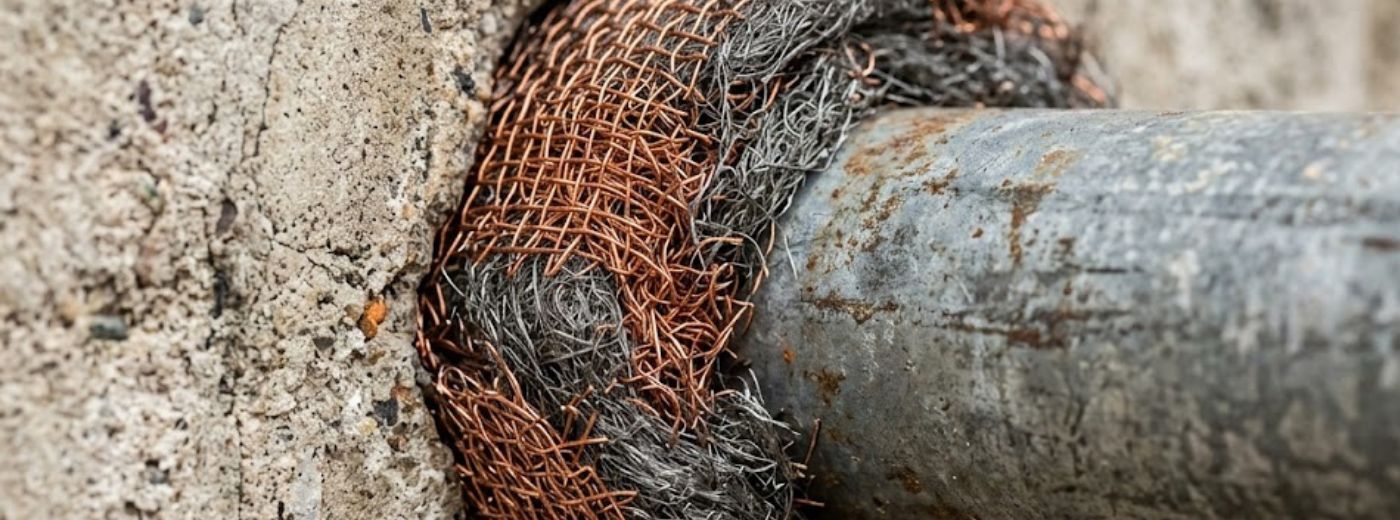
Copper mesh sealing of pipe penetration entry point to prevent mouse access in Macon home

Mouse proofing & sealing entry points in Macon, GA

House mice fit through a 6mm gap, the size of a dime. Every gap at or above that threshold, across every zone of the building envelope, has to be found and sealed. That's mouse proofing done correctly in Bibb County.

Call (844) 635-0403 All services Free Inspection · Same-Day Response · No Obligation
LicensedInsured6mm gap tolerance90-day warranty

Mouse proofing in Macon, GA requires sealing every gap at or above 6mm, the size of a dime, across the entire building envelope, from the roofline to the crawl space. This tolerance is smaller than rat exclusion (which focuses on gaps of 12mm and above), more granular to inspect, and harder to do completely. Because Macon's subtropical climate means house mice breed year-round without a cold-weather population reset, the outdoor mouse population continuously probes every building for any gap that gives access. Missing a single 6mm dryer vent gap undoes every other seal on the property. This page covers where those gaps consistently appear in Bibb County housing stock and how we find and seal all of them.

The dime-gap standard, and why it matters more in Macon

In most of the country, a homeowner who seals the obvious large gaps around pipe penetrations and foundation vents gets reasonable seasonal protection. Outdoor mouse populations drop in winter, reducing the pressure on small gaps that were always technically accessible but not heavily probed. In Macon, that seasonal reprieve doesn't arrive. The outdoor mouse population that lives in the landscaping mulch, the neighbor's crawl space, and the vegetated strip behind the fence is at roughly the same density in January as in August. A 6mm gap that gets ignored in September will be found and used by December. Year-round pressure demands year-round protection, which means the 6mm tolerance has to be taken seriously on every inspection.

The eight most common mouse entry points in Macon homes

Typical gap: 8–20mm

Dryer vent duct gap

The gap between the dryer exhaust duct and the circular cutout in the exterior wall. Almost never fully sealed, the duct is smaller than the hole, leaving a ring gap that mice enter easily.

Typical gap: 6–15mm

Gas pipe wall penetrations

Where natural gas lines enter through the exterior wall. The utility company installs the pipe, not the sealant, the gap around the pipe is almost always present and almost always accessible.

Typical gap: varies, screen often broken

Crawl space foundation vents

Pre-1970s Macon homes have aluminum or galvanized steel foundation vents that corrode, warp, and crack. A single broken vent screen gives crawl space access to the whole foundation perimeter.

Typical gap: 8–25mm

Garage door corner gaps

The lower corners of the garage door frame, especially on older slab-edge garages where the concrete has settled. Mice travel along the wall-floor junction and enter at the corner gap.

Typical gap: 6–12mm

Soffit-to-wall trim separation

On pre-1970s homes where fascia and soffit trim boards have pulled away from the wall surface. Common in the historic districts, trim separation exposes the wall cavity to mouse entry.

Typical gap: 6–20mm

HVAC line-set wall penetration

Where the refrigerant lines enter through the exterior wall to the indoor air handler. Installers don't usually seal the gap around the bundle, mice do.

Typical gap: 8–15mm

Plumbing supply line penetrations

Water supply lines entering through the exterior wall or crawl space wall, especially at exterior hose bib connections and utility room supply entries.

Typical gap: varies by settling

Mudsill-to-foundation gap

Where the sill plate meets the concrete foundation block on crawl space homes. Decades of settling leaves visible gaps at this joint on virtually every pre-1960s Bibb County home.
Mouse proofing process

1

6mm threshold inspection

Every zone inspected at the 6mm threshold: exterior perimeter, crawl space interior, attic perimeter, under sinks, behind appliances. Gap measurement is deliberate, we're not looking for obvious large gaps, we're looking for every gap at or above 6mm.

2

Infestation clearance confirmation

We confirm the mouse population inside is cleared before sealing. Any active sign means the trap program needs to run longer before we seal. Proofing an active infestation creates dead-mouse-in-walls problems.

3

Material-matched gap sealing

Copper mesh for round-profile pipe gaps, hardware cloth for larger vent openings, exterior sealant for irregular transitions. Dryer vent gaps get a dedicated dryer vent cover if the duct-to-wall gap is large. No foam-only seals.

4

Follow-up and warranty

Follow-up inspection 3–4 weeks post-sealing. We check for fresh droppings and inspect sealed points. Any of our sealed gaps that reopens within 90 days is re-sealed at no charge.

Stop mice at the wall, pro sealing holds in Macon's climate

Call (844) 635-0403
Licensed & insured Locally owned, Vineville-based Founded 2023 24/7 emergency response

Pricing for mouse proofing in Macon

Targeted, few entry points

$200 – $350

2–4 well-defined entry points. Newer building with limited gaps, usually dryer vent and 1–2 pipe penetrations on a slab-foundation home.

Standard residential

$350 – $550

4–8 entry points across multiple zones. Most Bibb County single-family residential mouse proofing jobs. Includes follow-up inspection and warranty.

Crawl space home, full seal

$550 – $700

Pre-1970s building with crawl space, multiple pipe penetrations, and soffit-to-wall gaps. Foundation vent re-screening plus wall and roofline gaps.

Inspection

Free

Full 6mm-threshold inspection across all zones with written entry-point map. No obligation to proceed.

What changes the actual number:
  • Property size and how many zones (attic, crawl space, garage, outbuildings) need inspection
  • Species mix and how established the infestation is
  • Number of entry points needing exclusion sealing
  • Whether records are required for insurance, landlord, or health inspection purposes

Want a real number for your situation? Call (844) 635-0403 for a free on-site inspection. Written quote before any work begins.

Frequently asked questions, mouse proofing in Macon

What gap size does mouse proofing need to seal?

House mice can squeeze through about 6mm, the size of a dime. Mouse proofing must identify and seal every gap at or above this threshold across the entire building envelope. This is smaller than rat exclusion tolerance (12mm) and means mouse proofing is more granular and catches gaps that rat exclusion misses.

Why does Macon have year-round mouse pressure?

Macon's humid subtropical climate means house mice breed continuously with no cold-weather population reset. In climates with true winters, outdoor mouse populations drop in winter, reducing building pressure. In Macon, the outdoor population sustains year-round, continuously probing building perimeters at the same density in January as July.

What are the most common mouse entry points in Macon homes?

Dryer vent duct gaps, gas pipe wall penetrations, crawl space foundation vents with broken screens, garage door corner gaps, soffit-to-wall trim separation on older homes, HVAC line-set penetrations, plumbing supply line entries, and mudsill-to-foundation gaps on crawl space homes.

How much does mouse proofing cost in Macon?

$200 to $700 for most residential properties. A newer home with 2–4 entry points sits at the low end. A pre-1970s home with a crawl space and multiple pipe and soffit-gap issues reaches the upper end. Inspections are free.

Can I do my own mouse proofing?

For a very limited number of clearly visible gaps, copper mesh and exterior sealant applied correctly can work. The challenge is finding all the gaps, mice fit through gaps that aren't visible without crawl space and attic inspection. Missing one 6mm gap undoes every other seal on the property.

Do you seal entry points in crawl spaces?

Yes. Crawl space sealing is part of every mouse proofing job on a home with a crawl space, foundation vent re-screening, pipe penetration sealing, and mudsill gap closing. The crawl space is usually the largest contributor to whole-house mouse access on older Bibb County homes.

How does Macon's humidity affect mouse proofing materials?

Standard foam sealants and steel wool deteriorate rapidly in Macon's humidity. We use copper mesh (non-corrosive), galvanized hardware cloth, and exterior-grade sealant rated for subtropical conditions, materials that hold through Macon's wet seasons.

How long does mouse proofing last in Macon?

3–6 years with correct materials. The main failure modes are settling gaps on older homes, storm damage, and dryer vent connections loosening from appliance vibration. Annual inspection catches new gaps before mice find them.

Will mouse proofing alone stop a mouse infestation?

Proofing prevents re-entry, it doesn't remove mice already inside. For an active infestation, combine with a snap trap program. Sequence matters: removal first (reduce population), then proofing (seal after activity drops).

Can you mouse-proof a house while mice are still in it?

No. Sealing while mice are active traps them inside wall voids, creating a decomposition and odor problem. We confirm clearance (trap activity at zero, no fresh droppings) before sealing. Proofing is always the final step.

Related services

📞 Call (844) 635-0403. Open 24/7