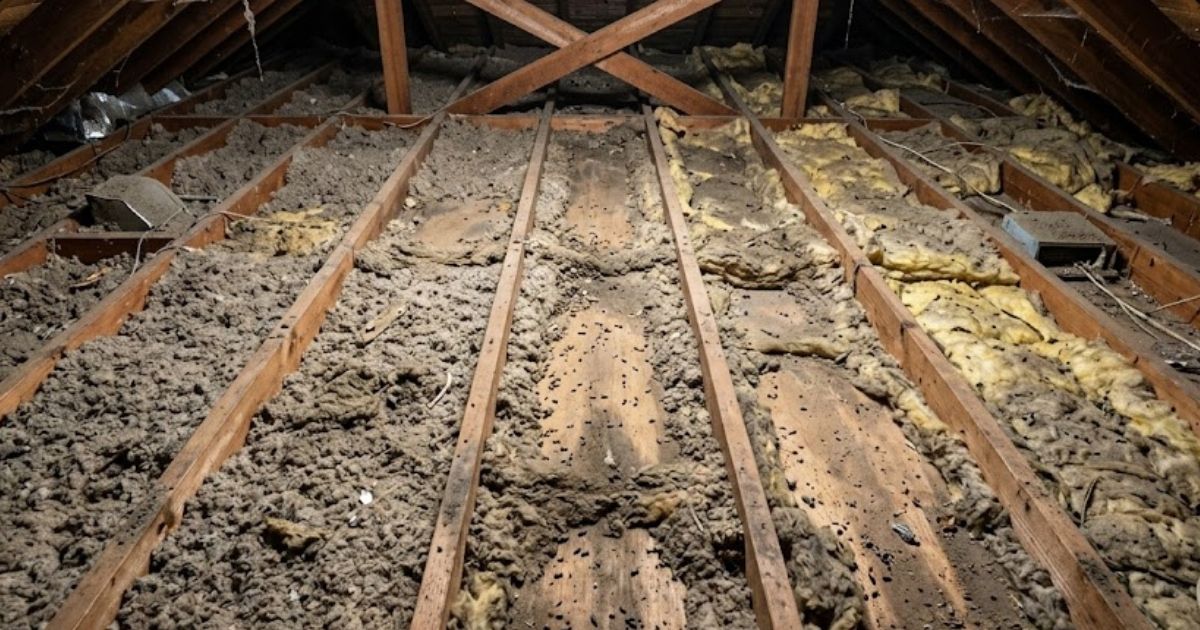
Roof rat attic infestations in Macon's historic neighborhoods are not increasing because rats have become more aggressive or more abundant in some general sense. They're increasing because three specific factors that make roof rat attic entry more likely have all been trending in the same direction for decades: the housing stock is getting older and more permeable, the canopy is getting larger and closer to rooflines, and the climate supports year-round breeding without the seasonal population resets that would keep numbers in check. Each of these factors compounds the others.
Aging building, the compounding gap inventory
A 1915 Vineville bungalow was built with building methods that were never intended to exclude rodents. The wood-shingle ridge vent, the open soffit return under the decorative fascia board, the wooden louver gable vent, these were ventilation systems, not barriers. In 1925, with the house 10 years old, the gaps at these locations were modest. In 2025, with 110 years of thermal cycling, moisture exposure, and wood movement behind them, those same gaps are much larger and the screening or material that was once there has deteriorated. Every decade, the average gap inventory on a pre-1940 Macon home gets larger. The homes that were marginally accessible to roof rats in 1985 are a lot more accessible today, and the homes that were closed to roof rats in 1985 may no longer be. The aging of Macon's oldest housing stock is a slow, continuous process of increasing vulnerability.
A century of canopy growth
The pecan trees in Vineville didn't plant themselves. The live oaks in Ingleside have been growing since before those neighborhoods' oldest homes were built. A century of canopy growth has produced trees that are taller, wider, and more branch-dense than they were when the homes around them were new. A branch that was 6 feet from the nearest roofline in 1970 may now be touching the soffit. A tree that didn't overhang any roofline in 1950 now overhangs three. Canopy growth is directional and slow enough that homeowners often don't notice it, but it continuously narrows the gap between trees and rooflines that roof rats need to cross. The aerial highway available to roof rats in Macon's historic neighborhoods is longer and better-connected today than it was 40 years ago.
Year-round breeding without population resets
Macon's subtropical climate means roof rats breed year-round without the cold-weather population crash that limits roof rat populations in temperate climates. A roof rat pair that establishes in a Macon attic in January will produce litters in February, April, June, August, October, and December if undisturbed, each litter averaging 6 to 8 pups, with pups reaching reproductive maturity in 3 to 4 months. The compounding math of year-round breeding with no population reset produces attic colonies that are much larger and more established than equivalent infestations in cooler climates. The absence of a winter that kills off a major portion of the outdoor population means that the pressure on rooflines in Macon never meaningfully drops. Each year without exclusion sealing is a year of continuous and growing pressure.
What reverses the trend
None of these factors is irreversible at the individual home level. Aging building is addressed by systematic exclusion sealing with durable materials. Canopy access is addressed by targeted trimming to clear branches within 3 to 4 feet of the roofline. Year-round population pressure is managed by combination of exclusion (closing entry) and perimeter pressure reduction where ongoing programs are warranted. The trend that makes Macon's historic neighborhoods more vulnerable each decade doesn't have to apply to any individual home that stays current with roofline inspection and exclusion upkeep. The homes in Vineville and Ingleside that don't generate repeat roof rat calls are the ones whose owners treat exclusion as ongoing upkeep rather than a one-time fix.
The renovation effect, temporary openings, lasting infestations
One trend has affected Macon's historic neighborhoods over the past 15 to 20 years. Home renovation activity. It temporarily opens building envelopes. That accidentally gives roof rats a chance to settle in. A Vineville bungalow under renovation often has openings. The roof partially exposed during section reroofing. Soffit removed during fascia repair. Wall sections opened during interior renovation. These openings are temporary from the contractor's perspective (the work will be finished and the envelope closed in days or weeks), but from a roof rat colony's perspective they're an opportunity to establish in a previously inaccessible attic. The colony establishes during the renovation window, the renovation completes with the roofline back in place but with the colony now inside, and the homeowner moves back into a finished renovation that has an attic infestation they didn't have before the work began. We see this pattern frequently, renovation-triggered infestations in homes with no prior history of activity. The preventive measure is straightforward: any renovation that opens the building envelope in roof rat neighborhoods should include temporary mesh or barrier work across openings during the work, and a post-renovation rodent inspection before finishing interior work in adjacent attic-accessible areas.
Solar panel work as a new entry pathway
A more recent trend relevant to Macon homeowners considering solar panel installations: the racking systems that attach solar panels to rooflines often create new entry openings or expose previously sealed openings during work. Roof penetrations for mounting hardware, the gap created between the panels and the roof deck, and the wiring runs that transit attic spaces all introduce work-era entry opportunities. Solar installers are not rodent control specialists and don't necessarily address the entry-point implications of their work. Macon homeowners who have installed solar in the past 5-10 years should inspect the racking-to-roof junction and the wiring run pathways for rodent entry signs. We've worked on multiple Vineville and Ingleside homes where the solar work introduced the entry point that allowed a subsequent roof rat colony to establish. This isn't an argument against solar, but it is an argument for rodent-focused inspection of the solar work before and after the work.
The neighborhood density tipping point
One harder-to-discuss factor matters more in Macon's most affected neighborhoods. The cumulative roof rat population density across many nearby homes can cross a threshold. Past that point, individual home exclusion works much less well. A single sealed home in a neighborhood of unsealed homes still has limited risk. The surrounding pressure stays low. Rats spread across many accessible attics. But a neighborhood where dozens of homes have ongoing infestations supports a continuously growing population that puts increasing pressure on every roofline, sealed or not. Vineville and Ingleside have shown signs of approaching or passing this tipping point, individual exclusion work in these neighborhoods now sometimes requires more aggressive upkeep to hold against the neighborhood-level pressure than the same work in lower-density-pressure areas like Avondale or Kings Park. The solution at the neighborhood level is collective action, multiple homes addressing roof rat infestations simultaneously and keeping exclusion together. Practically, this happens informally when neighbors share information about successful pest control providers and treatment approaches.
What the future looks like without intervention
Projecting current trends forward, the trajectory for Macon's historic neighborhoods over the next 20 years involves further increases in cumulative pressure unless individual and neighborhood-level exclusion work increases proportionally. The canopy will continue growing, building will continue aging, and the breeding population will continue compounding. Homes in Vineville and Ingleside that haven't been fully exclusion-sealed by 2035 will be facing meaningfully higher attic rat pressure than they face today. The flip side: homes that have been fully sealed and kept up through this period will benefit increasingly from the relative reduction in attractive habitat compared to their unsealed neighbors. The investment timeline for thorough exclusion work in Vineville or Ingleside has a payoff that extends 20-30 years, which is genuinely unusual for residential pest control work. Most pest control investments have payback periods measured in months or years; full heritage-compatible exclusion in Macon's historic neighborhoods pays back over decades.
Hearing nighttime activity in your Macon attic? Attic-only inspection is part of our standard five-zone walk-through. (844) 635-0403 — free initial visit.