Attic, wall-void, and crawl space nest extraction for roof rat and Norway rat infestations, including enzyme treatment of the nest site and check of the pheromone signal that makes re-infestation more likely if nests are left in place.
Rat nest removal in Macon, GA matters beyond just the immediate cleanup, rat nests are pheromone beacons that signal to subsequent cohorts from the outdoor population that a location has been successfully used before. A roof rat colony cleared from a Vineville attic, with exclusion sealing complete and entry points sealed, still has an elevated re-infestation risk if the nests are left in place. The scent compounds embedded in nesting material, gland secretions, urine markings, individual rat pheromones, persist in the nesting material for months after the colony is gone. Removing the nests eliminates both the contamination and the attraction signal.
Roof rats build enclosed globular nests in upper insulation, in attic corners where two roof slopes meet, and along joist bays near the gable end. Nests are built from shredded blown-in insulation, paper, and plant material.
Roof rats occasionally nest in upper-floor wall voids adjacent to the attic space, especially in homes with open top-plate-to-roof connections. Less common than attic nesting but occurs in older building with connected attic-wall void space.
Norway rats nest in crawl space corners and beneath batt insulation hung between joists. Nests are built from insulation fibers, debris, and plant material and are usually at or below grade level.
Norway rats occasionally nest in wall voids at or near floor level, especially in areas adjacent to the crawl space where pipe chases give access. Droppings and grease marks at floor-wall junction shows floor-level wall void nesting.
House mice build small, compact nests inside appliance insulation (range, refrigerator backs), inside cabinet-base wall voids, and in attic corners. Mouse nests are smaller and more numerous than rat nests, expect 6–12 per established infestation.
Macon's cooler months drive mice to nest adjacent to heat sources, water heater enclosures, furnace surrounds, range insulation cavities. These nests are small but create fire risk from nesting material contact with heat-producing equipment.
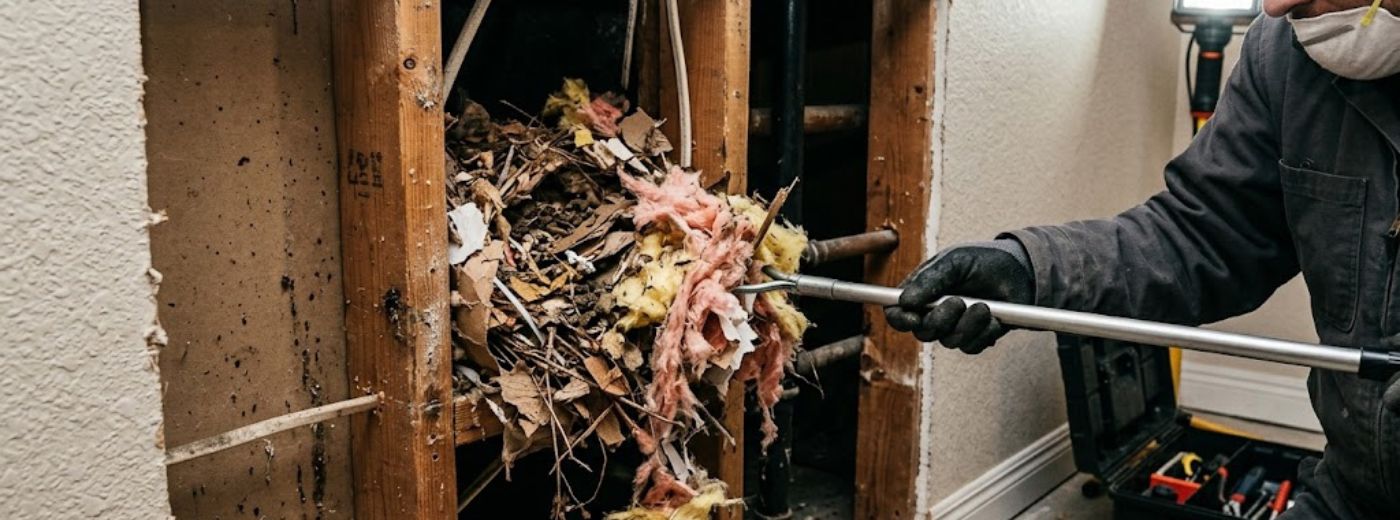
Nest removal happens after the active population is reduced by trapping, not during active infestation. Removing nests while the colony is active prompts immediate rebuilding in the same location.
Full attic or crawl space inspection to identify all nest locations. Roof rat infestations often have 2–4 nest sites; mouse infestations may have 6–12. All sites recorded before removal begins.
Nests extracted with right PPE, N95 minimum, P100 for larger accumulations. Wet-first protocol applied before physical handling to minimize aerosolization. All nesting material double-bagged for disposal.
Enzyme-based disinfectant applied to the structural surface at each nest site to break down pheromone compounds and pathogen load. Standard disinfectant addresses pathogens; enzyme product addresses pheromone compounds .
1–3 identified nest sites in an accessible attic. Extraction, enzyme treatment, and records.
4–8 nest sites across an attic or crawl space. More extensive infestation with multiple colonies using the same space.
Established mouse infestation with 6–12 nest sites in wall voids, cabinet bases, appliance cavities, and attic corners. Per-nest enzyme treatment.
When nest removal is part of a full attic cleanup and sanitization program, it's included in the cleanup program scope rather than separately invoiced.
Want a real number for your situation? Call (844) 635-0403 for a free on-site inspection. Written quote before any work begins.
Roof rats in Macon nest almost exclusively in attics, in insulation, upper corners, and joist bays. Norway rats nest at or below grade, crawl space corners, beneath batt insulation, and in wall voids at floor level. House mice nest wherever they find an undisturbed cavity: cabinet insulation, wall voids adjacent to heat sources, and attic corners.
Yes, for two reasons. Rat nests contain pheromone markers that signal to subsequent cohorts that a location is safe and established, increasing re-infestation risk. And nest material carries droppings, parasites, and pathogens that create ongoing health risk. Nest removal eliminates both the pheromone signal and the contamination.
$150 to $500 as a standalone service depending on nest count, location, and accessibility. When included in a full attic cleanup program, it's part of that scope rather than separately invoiced.
After treatment reduces the active population, and before or simultaneously with exclusion sealing. Removing nests before the colony is reduced prompts rebuilding. Removing after clearance and before exclusion sealing eliminates the pheromone signal before the next cohort can find it.
Yes. Rat nests are saturated with scent compounds that persist long after the colony is gone. These signal to new rats that the location has been used successfully before, a lot lowering the barrier for the next cohort to establish in the same spot.
Yes. Mouse nest removal follows the same protocol. Mouse nests are smaller and usually more numerous, an established mouse infestation may have 6–12 nest sites in wall voids, cabinet backs, and attic corners, compared to 1–4 for a comparable-duration roof rat colony.