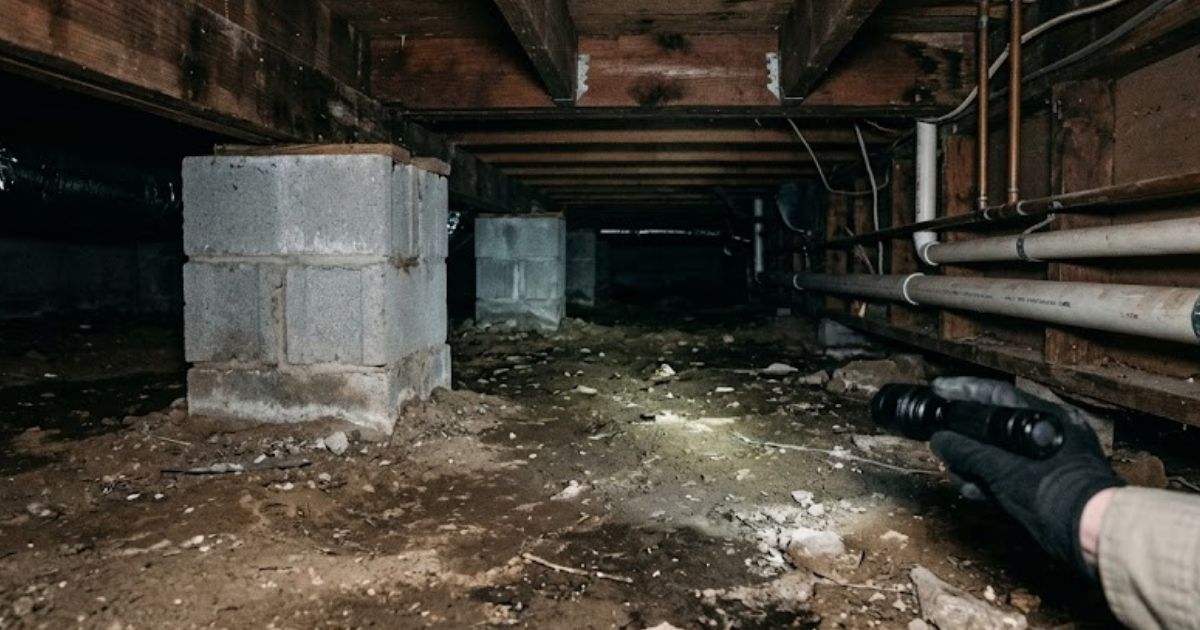
A crawl space in Macon, Georgia is almost ideally suited to rodent nesting, not because Macon's homes are poorly built, but because of a specific combination of climate, soil type, and building era that creates conditions that improve for rodents every year the home ages without systematic exclusion work. Understanding why helps homeowners make better decisions about what treatment approaches actually address the problem and which ones just manage the symptoms.
Macon's humidity sustains year-round crawl space conditions
Macon averages 51 inches of rainfall annually and summer humidity regularly exceeds 80 percent. An unencapsulated crawl space in Macon maintains humidity conditions year-round that a crawl space in a drier climate has only during wet season. This means the crawl space environment in Macon stays warm and humid in conditions that rodents find comfortable in January as well as July, there's no winter dormancy, no dry-season period when the crawl space becomes inhospitable. The outdoor rodent population pressing against the foundation is at roughly the same density and activity level year-round, and the crawl space environment is equally welcoming year-round.
High-clay soil settling opens entry points progressively
Macon's soil is predominantly high-clay, it expands a lot when wet and contracts when dry. This moisture-driven movement cycles with every rain event and every dry spell, slowly but continuously working the structure of any foundation that sits on it. The most consistent result of decades of clay soil movement under Macon's older housing stock is the mudsill gap: the joint where the sill plate rests on the foundation block opens progressively as the concrete block settles relative to the framing above it. On a 30-year-old home, this gap may be a few millimeters, enough for mice but not rats. On a 70-year-old home, it may be 12 millimeters or more, accessible to Norway rats. The gap doesn't appear all at once; it develops silently over decades of normal soil movement.
building era sets gap inventory
Post-war Macon homes, those built from roughly 1945 to 1975, were built with materials that have had 50 to 80 years to corrode, crack, and separate. Aluminum foundation vent screens corrode and fail. Galvanized steel vent screens rust through. Pipe penetrations through the crawl space foundation walls were installed without sealant as standard practice. The cumulative entry-point inventory on a 1955 Macon ranch home, corroded foundation vents, mudsill gap, multiple pipe penetrations, access hatch frame gaps, is usually 5 to 9 distinct rodent entry points. On a 1925 bungalow in Ingleside, it may be 12 to 16. The home wasn't built defective; it's just aged into a condition that wasn't anticipated by the original building.
Why crawl space treatment without crawl space entry fails
The single most common reason crawl space rodent problems in Macon persist despite multiple treatment attempts is that the operator never entered the crawl space. Exterior-only crawl space inspection, looking in through the foundation vent openings, sees the foundation vent screen condition and the visible perimeter. It does not see the mudsill gap (visible only from inside, looking up at the sill plate-to-foundation junction), the pipe penetrations on the interior face of the foundation walls, or the interior foundation wall gaps between divided crawl space sections. We enter every Macon crawl space on every inspection, because the gaps we find most often are the ones that aren't visible from outside.
The right fix, and why it's mechanical, not chemical
Rodenticide placed in crawl spaces reduces the population that's already inside but doesn't stop new entry from the outdoor population. Bait stations in crawl spaces create secondary poisoning risk and dead-rodent-in-wall problems. The durable solution for Macon crawl space rodent problems is structural: re-screening foundation vents with hardware cloth mechanically fastened to the vent frame, sealing mudsill gaps with copper mesh and exterior sealant applied to the interior face, and closing pipe penetrations on the crawl space wall interior. Materials have to be mechanically fastened rather than adhesive-only because Macon's clay soil movement stresses adhesive bonds at the concrete face. Hardware cloth and copper mesh that's mechanically fastened holds through soil movement and humidity cycles that foam-only seals don't survive.
The encapsulation question, and why it's not a rodent solution
Many Macon homeowners ask one question. Does crawl space encapsulation solve rodent problems alongside its moisture-management benefits? Encapsulation means installing a vapor barrier. And sealing the crawl space from outside air. The honest answer: done correctly, encapsulation improves rodent control a lot. The reason: it requires sealing every foundation vent. Every wall penetration. Every gap in the crawl space envelope. The encapsulation contractor's work overlaps a lot with exclusion work. But encapsulation is not designed mostly for rodent exclusion, and an encapsulation job done without rodent-specific attention to the mudsill joint, the access hatch frame, and any utility penetrations may leave major entry points unsealed. If you're considering encapsulation, coordinate the rodent inspection before the encapsulation work begins so that any rodent-specific concerns are addressed during the work. Sealing the crawl space envelope with rodents still inside is also a problem, the rats are now sealed in with no easy exit and will work harder to find new exits, often by chewing through the new vapor barrier or framing in unpredictable locations.
The pier-and-beam change
Macon's older housing stock often uses pier-and-beam foundation building. The pattern is strongest in pre-1940 building. That's Vineville. Ingleside. The older downtown-adjacent neighborhoods. Mid-century homes use continuous concrete block foundations instead. Pier-and-beam crawl spaces present a different exclusion challenge. There's no continuous foundation perimeter to seal. Instead, the home rests on individual masonry piers. The space between piers is either open. Or it's filled with skirting that may or may not be intact. The exclusion approach for pier-and-beam homes is really building a new continuous perimeter, installing pressure-treated lumber and hardware cloth skirting around the entire foundation perimeter, with proper ventilation openings. This is more big work than re-screening foundation vents on a block foundation, and it's why exclusion costs on pier-and-beam Macon homes run higher than on equivalent-size block-foundation homes. The good news is that once properly installed, pier-and-beam skirting holds for decades because it doesn't depend on the same soil-movement-stressed seal joints that limit block foundation exclusion durability.
The dehumidifier strategy, partial moisture-side control
For homeowners not ready to invest in full crawl space encapsulation but wanting to reduce the humid environment that makes the crawl space attractive to rodents, a dedicated crawl space dehumidifier addresses the moisture side of the problem without addressing the entry-point side. A properly sized crawl space dehumidifier can bring relative humidity down to the 50-55% range that's much less hospitable to rodent nesting (and to mold growth). This isn't a substitute for exclusion, the rats can still enter, but it makes the crawl space a less attractive nesting environment, which over time reduces the established population pressure. We sometimes recommend a dehumidifier as a complement to exclusion work on older Macon homes where the crawl space has chronically high humidity that won't be addressed by foundation vent re-screening alone. The combination of exclusion plus dehumidification produces better long-term results than either alone on humidity-prone properties.
What the inspection should always cover
For homeowners scheduling a crawl space rodent inspection on a Macon property, here's what a thorough inspection should include: physical entry into the crawl space (not just looking through vent openings), full perimeter check of the mudsill joint from inside, inspection of every foundation vent screen from both sides, records of every pipe and utility penetration with measurement of any visible gaps, check of the access hatch frame and seal, evaluation of insulation condition and any visible contamination, soil-level inspection for burrow activity and runways, and records of any moisture-related conditions (standing water, vapor barrier failure, wood rot at sill plates). The written report should locate each finding , not "foundation vents need attention" but "northeast corner vent screen torn, southeast wall mudsill gap about 12mm, water heater drain pan crawl space penetration unsealed." If the inspection isn't recorded at this level of specificity, the resulting treatment plan won't be specific either.
Crawl space rodent activity needs specific exclusion materials and approach. Our crawl space inspection covers vents, plumbing penetrations, and rim joist gaps. Call (844) 635-0403.